Adult-Children of alcoholics & other narcissists



The Nonviolent Communication Model:
Marshall Rosenberg, in his groundbreaking book Nonviolent Communication (NVC), introduced a model for expressing needs in healthy relationships :
-
1.Observation: Communicate clearly by describing what you hear or see, what you like or dislike, without judgment, evaluation or blame : “John, I notice that your clothes are on the floor”
-
2.Feeling: Share your emotions about the action or pattern you observe, so that you are ‘known’ by the other e.g. “I feel hurt, scared, happy or angry”
-
3.Need: Your needs indicate what your values are, and how they are connected to the observation. e.g. “John, I notice that your clothes are on the floor, and I feel irritated because I have a need for a clean house.” Important: note that the need is not about John picking up his clothes.
Because needs are an expression of our values that are important to us, they tend to be broader & and more general, such as, “I need to feel appreciated”; “I need to be professional and on time”; or “I have a need to be honest and open with those I love”.
-
4.Request: Lastly, make a request for change - it’s something you want from the other that would enrich your life. So the last part of the example might be “John, I would really appreciate it if you would pick up your clothes and put them in the laundry.”
You can also use it in reverse - to deepen your empathy & connection with your partner. Use the four steps to sense what your partner might be Observing, Feeling and Needing - which you might be able to provide, by thinking of what might enrich their life, using #4 as a question. The 4 steps could be a wonderful way to deepen your relationship, as well as communicating your needs in a way that you can truly be heard.
RELATIONSHIPS
Gays & Lesbians

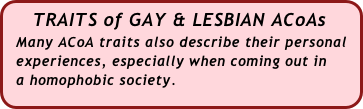
1.We lack a sense of wholeness of self; we define
ourselves as ok or not ok by the external
reactions of others
2. We react to others from a one down position,
fearful of being found out
3. We fear what might happen for being different;
we either avoid anger & upset in others by
silence or compliance, OR provoke rejection by
exaggerating our differences
4. We feel we must earn our self-worth, constantly
looking for the approval of others & judging
ourselves harshly when we don’t succeed
5. We don’t trust those who seem to be part of
the heterosexual majority & anyone who’s in a
one-down position
6. We don’t take a stand or make a commitment
easily, fearful of increasing our sense of
vulnerability; we often go in & out of coming
from opposing positions
7. We don’t allow ourselves spontaneity,
constantly on guard against possible attack
8. We don’t know how to engage in give-&-take
relationships, unsure what we have to give, &
desperately needing what might be offered
9. We need to feel in control of others’ reactions &
don’t feel ok with changes from outside sources
-
10.We don’t know how to express a full range of
emotions, being used to suppressing their
outward expression, or else exaggerating
distortions of our true feelings
-
11.We pride ourselves in creating consistencies
or in resolving difficulties for others
-
12.We feel over-responsible for others, glad to
help, but avoid asking for help ourselves
-
13.We turn to compulsive rituals to promote the illusion of control, thereby suppressing the
pain of not belonging
-
14.We don’t know the meaning of intimacy; we
confuse our gratitude of others’ approval
with love


Home • SITE MAP • About Me • ACoA Traits • Article • Books • BLOG • Boundaries • Co-Dependence • Course • Decisions • Definitions • Effective Responses • Emotions • Family Roles • Friends • Healthy Rules • Inner Child • Links • Love • Recovery • Relationships • Toxic Rules • Trust